

Solution Views in Spaces
Unifying navigation through clear, solution-based context
1. Problem Framing
Kibana’s navigation and home experience were built before Elastic’s solution-based product strategy fully emerged. As Elastic grew, users began to think in terms of solutions — Security, Observability, Cloud — while Kibana still organized workspaces through an abstract concept called Spaces.
This mismatch led to fragmented onboarding, unclear ownership, and difficulty switching between solutions. To fix it, we needed to evolve Kibana from a flat, app-centric experience to one structured around solution context — without breaking compatibility for existing deployments.
The first step was reinforcing the Spaces user experience itself — simplifying setup, improving orientation, and ensuring a stable technical foundation. Only then could we layer in Solution Views, the second phase, to present Kibana through a clear, solution-based lens that reflected Elastic’s modern platform direction.
I led design direction across both phases, collaborating closely with PMs and engineers from all major solution teams.
2. Design Process & Decision-Making
We began by auditing how Spaces were being used across solutions. Through telemetry, internal interviews, and FullStory sessions, we found the issue wasn’t functionality — it was meaning. Users didn’t understand what a “space” represented, so we clarified its purpose and visual structure before introducing any new paradigms.
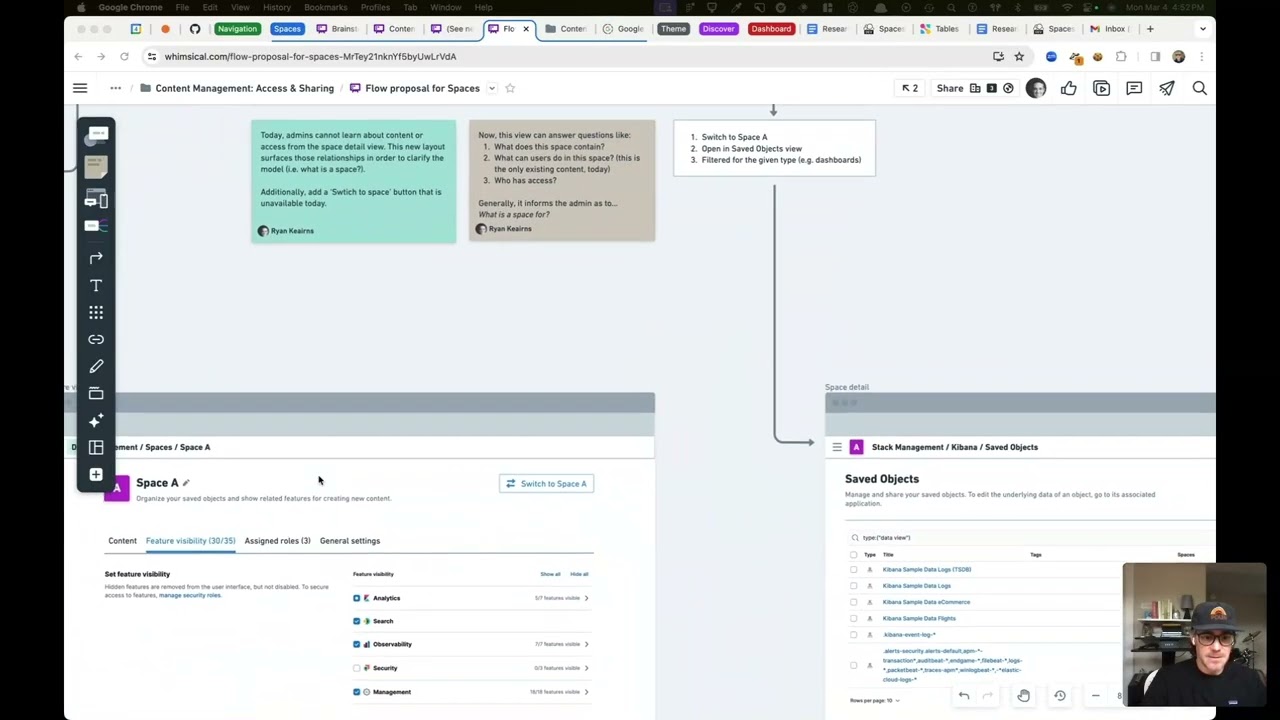
Phase 1 — Strengthening Spaces
Our goal was to make Spaces intuitive and trustworthy as a foundation:
- Simplified creation and management workflows
- Clearer hierarchy and context labeling
- Unified visual and interaction patterns across solutions
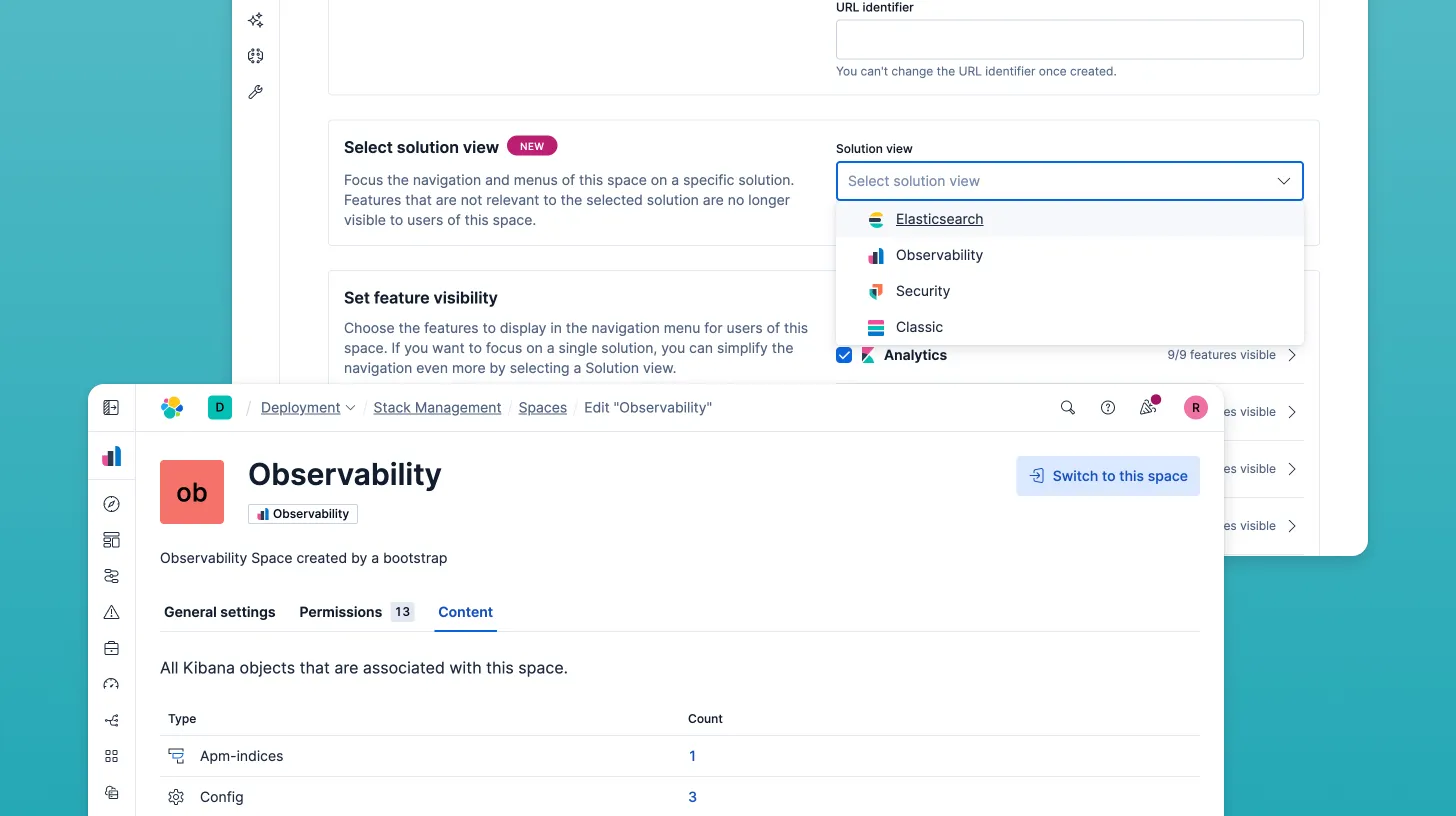
Phase 2 — Introducing Solution Views
Once Spaces were solid, we extended the same framework to represent Solutions directly:
- Mapped the solution view concept to Spaces
- Introduced visual and navigational cues for solution identity
- Preserved backward compatibility for roles and permissions
Alternatives Considered
- Option 1: Introduce a new “Projects” layer, mimicking the serverless model
- Option 2: Visually repurpose Spaces as Solution Views (chosen)
- Option 3: Merge Spaces and Solutions entirely
We selected Option 2 for its low friction and clear path to incremental rollout — immediate clarity for users, minimal disruption for admins.
3. Collaboration & Delivery
This effort required deep collaboration between Platform and solution teams. I led weekly design syncs to align on terminology, hierarchy, and data flows, and built a reference prototype that became the shared source of truth for design and implementation.
Engineering integrated the update behind a feature flag, enabling an internal rollout before customer exposure. This phased approach let us validate user understanding and measure adoption safely.
One key trade-off: we deferred user-level customization (e.g., personal default views) to keep the MVP lightweight and technically feasible. That exploration later evolved into User-Based Solution View Switching, a separate POC.
4. Impact
The two-phase rollout achieved its goals:
- Phase 1: Stabilized and clarified Spaces, increasing confidence and discoverability.
- Phase 2: Delivered solution-based views that improved orientation and aligned Kibana’s structure with Elastic’s product strategy.
New trials and deployments saw improved first-session success and faster context switching (measured via FullStory completion rates).
Internally, the project strengthened cross-team alignment — Platform, Security, and Observability now shared a common design and development cadence.
5. Visual Craft & Systems Thinking
The focus was on scalable structure, not decoration. By refining hierarchy, spacing, and contextual cues, the layout could adapt gracefully as new solutions and views were added.
These visual and interaction patterns later informed solution switching, home page layouts, and broader cross-app navigation — establishing a consistent, extensible framework for future Kibana experiences.
6. Communication & Storytelling
This project showed how aligning architecture with mental models simplifies complexity at scale.
By first reinforcing Spaces and then layering in Solution Views, we delivered both immediate clarity and long-term flexibility — a model for how Platform UX can bridge product vision, design systems, and technical evolution.
Impact
Transformed Kibana’s navigation into a scalable, solution-oriented system — aligning user experience, product architecture, and organizational structure around a single cohesive model.